Beyond the classroom · 2026

Our
Stories.

Stories of learning, discovery and collaboration from the ARU–CJLU community, inside and beyond the classroom.

From our community
Jingzhou, Hubei, China

From Python to industrial robots: a view from China's National Skills Competition

A student shares a glimpse of how programming, machine vision and automation meet in a national skills competition.

Shared by Zhaozhao Zhou ARU–CJLU student
What the student saw Four interconnected technologies
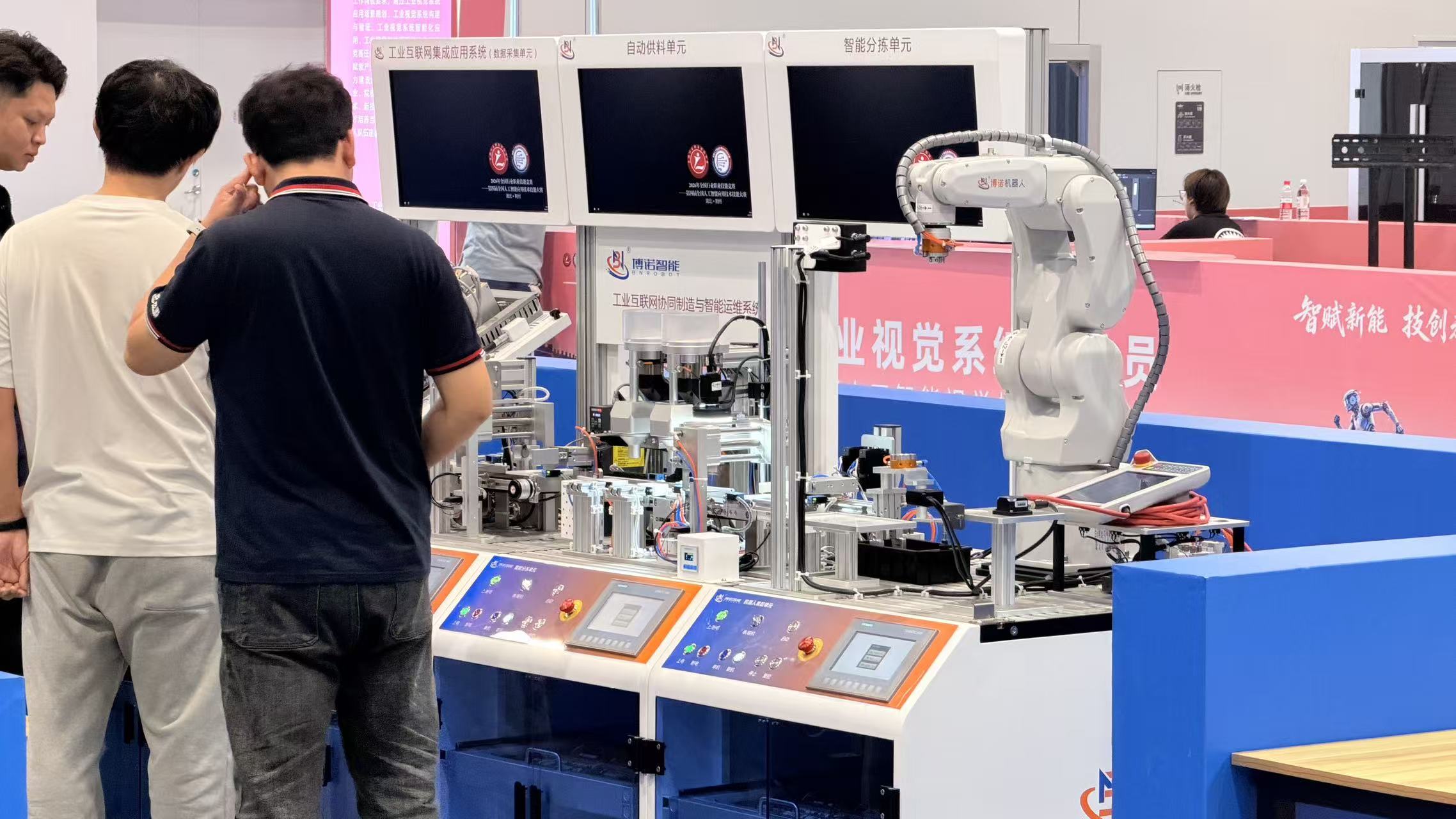
Industrial robot and automated workstations at the Jingzhou National Skills Competition
Industrial robotics and automated manufacturing equipment at the National Skills Competition in Jingzhou, Hubei. Photograph shared by Zhaozhao Zhou.
InstrumentationInstrument and meter manufacturing
Industrial visionAI-enabled inspection and maintenance
Robotic systemsIndustrial robot operation
PythonA shared programming tool across platforms

While participating in a National Skills Competition in Jingzhou, Hubei, Zhaozhao sent a field note from the event. He described contestants from universities across China and shared photographs of industrial equipment, robotic systems and practical workstations.

He highlighted three competition areas: Instrument and Meter Manufacturing, Industrial Vision System Operation and Maintenance (AI track), and Industrial Robot System Operation.

What stood out to him was a common thread connecting the different platforms: Python. The same language students use for exercises in machine learning can also help connect cameras, instruments, data and automated machines in practical settings.

The experience is a reminder that code is more than an exercise on a screen. It can become part of the machinery that measures, observes and acts in the world.
Fujian, China · 2026

From medical imaging to AI: Chaopei Yu's next chapter

Twelve years of clinical engineering experience, national recognition and a new challenge: learning artificial intelligence.

Shared by Chaopei Yu · Clinical engineer, university lecturer and ARU–CJLU learner

A career can be full of achievements and still leave room for a new beginning. For Chaopei Yu, the next chapter is artificial intelligence.

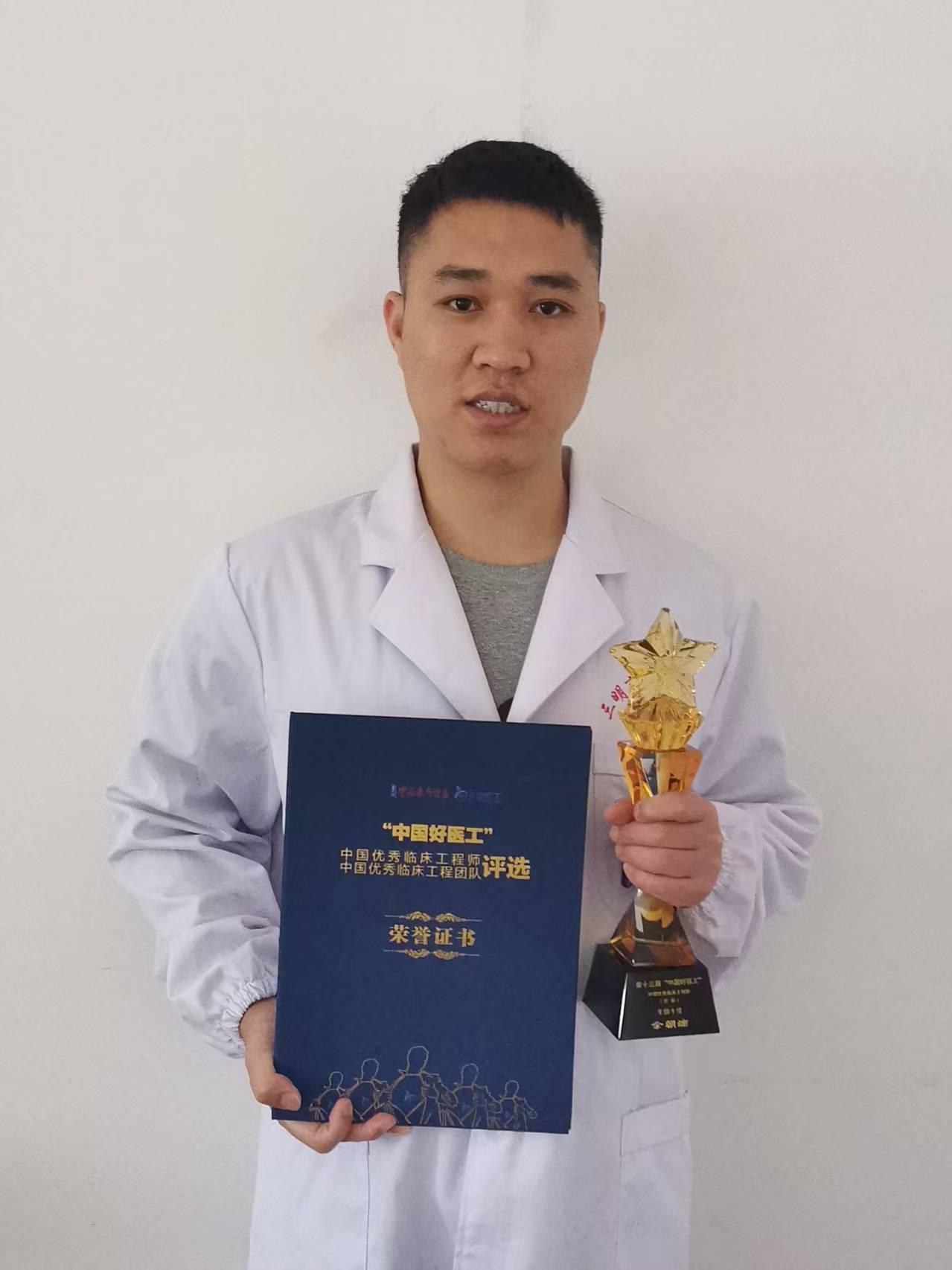
Chaopei Yu wearing a white clinical coat and holding a certificate and trophy
Chaopei Yu with a certificate and trophy, reflecting his achievements in clinical engineering. Photograph shared for this story.

Chaopei works in medical device management at the First Hospital of Sanming City and also teaches at university level. His undergraduate training was in Medical Imaging Technology; he later earned a master's degree and built a career connecting healthcare, technology and education.

Along the way, he has received recognition at national, provincial and municipal levels. Chaopei shared that he was awarded the title of “Outstanding Clinical Medical Engineer of China”, placing first nationwide. He recalls that an online broadcast connected with his national recognition attracted more than 20,000 viewers. He also described mentoring students who earned bronze and silver awards at the World Vocational Skills Competition.

Now, after twelve years in his profession, studying AI means entering a field beyond his original specialism. He is also strengthening his English communication skills, approaching both challenges with the same determination that shaped his engineering and teaching careers.

There is another side to his story. Chaopei comes from Fujian, a province he speaks about with affection, especially its tea culture. He hopes visitors will discover the region's traditions, food and cities, including Xiamen, Quanzhou, Putian and Zhangzhou.

His journey connects several worlds: medical imaging, the practical work of keeping clinical technology running, teaching the next generation and learning the tools that may reshape healthcare. Expertise, his story suggests, is not the end of learning. It is one of the places where learning begins again.

AI and Ethics · 29 October 2026

Beyond the AI slowdown: the Four As for governing frontier AI

Not all AI risks are the same. A new governance framework asks four different questions about what powerful AI should be permitted to do, who should use it, who decides and who benefits.

By Kirti Prakash and Ian van der Linde · Anglia Ruskin University

Read the paper in AI and Ethics
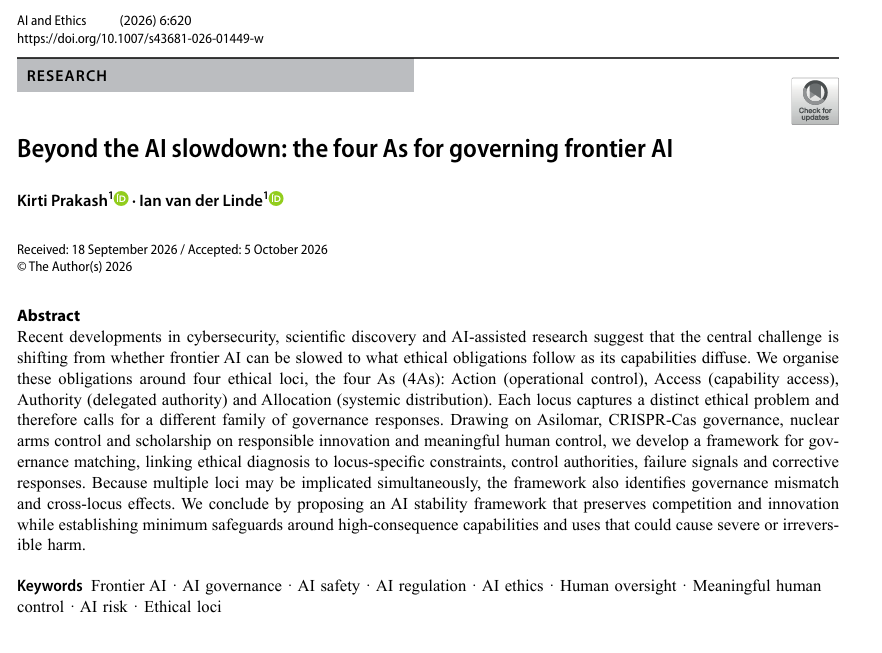
First page of the AI and Ethics article Beyond the AI slowdown: the four As for governing frontier AI, by Kirti Prakash and Ian van der Linde
Published research in AI and Ethics (2026). Select the image to read the paper.
Four ethical questions · Four governance responses

One AI risk framework isn't enough.

Rather than treating frontier AI risk as a single problem, the paper distinguishes four ethical questions that call for different forms of governance.

01
Action

Can humans constrain consequential AI behaviour?

Operational control
02
Access

Who can or should use powerful AI capabilities?

Capability access
03
Authority

Which decisions should AI make?

Delegated authority
04
Allocation

Who gains, who bears the costs and who holds power?

Systemic distribution

The central argument is straightforward: different risks require different forms of governance. Better technical control does not automatically settle who should have access to AI capabilities, whether important decisions can legitimately be delegated, or how benefits and costs are shared.

The framework also asks a second, easily overlooked question: can solving one AI risk create another elsewhere? Restricting access, for example, may reduce opportunities for misuse while also concentrating technological power. Good governance therefore needs to examine the consequences of its own safeguards.

We thank Anglia Ruskin University for featuring the work.

The next chapter

Everyone has a story.

Competitions, research visits, published papers, coding discoveries and collaborative projects all belong here. This page is designed to grow with our community.

Please share a short write-up and approved photographs with the Github team for a future story.

Explore student profiles